Since arriving in the U.K. a month ago, I have some surprises and frustrations when it comes to dealing with money, not unexpectedly, of course. I knew I’d encounter some initial hiccups and was warned by previous Fulbright recipients of what I might run up against while trying to live and work in another country.
But first, here’s some of the cash – or, pound notes:


They are prettier than American dollar bills and remind me of Canadian money in the color, texture, and size. I would imagine the coloring helps it to be less likely a target for counterfeiting. The oval shape in the middle (see where someone wrote a secret code?) is a watermark, so when you hold it to the light you see the queen’s portrait. Other security features include a hologram and these features. The other people on the bills are Charles Darwin and Adam Smith (A Scottish philosopher and economist). Bills not shown: an old paper £5 note, features Elizabeth Fry (prison reformer), the new replacement polymer £5 showcasing Winston Churchill, and the £50, which has steam engine inventors Boulton and Watt. The paper five will go out of circulation on May 2017, so if you got them, use or deposit them! (The identity and type of current banknotes from the Bank of England website.) The other paper notes will be replaced in subsequent years.
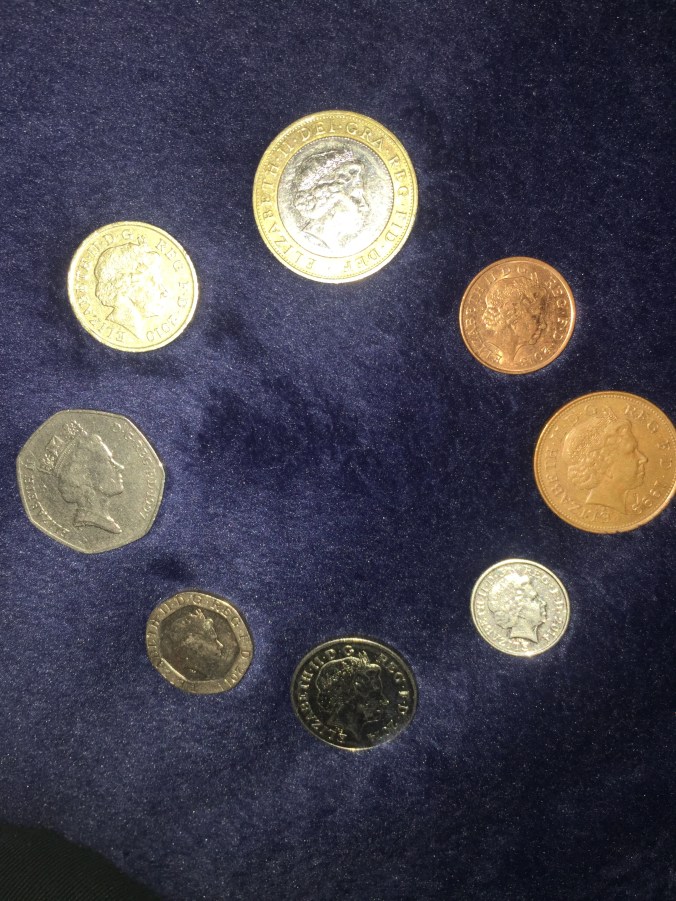
Mostly, I carry around a bunch of pound coins.From a Bank of England’s currency standpoint, they last much, much longer than paper notes. The drawback? Soooo heavy.
Starting at about the two o’clock position, the coins are Pence (slightly larger than a US penny), Two Pence, Five Pence, Ten Pence (at the bottom), Twenty Pence (with angled cut), Fifty Pence, A Pound (smaller than a quarter), and Two Pounds. The pound coin is thicker than the others – and heavier – which is helpful when blindly digging into a pocket or purse to find tip money.
If you were around before 1971, you would have used a different monetary system in England, with a 240 based, instead of a 100. (Argh! The Maths!) Here’s a clear explanation of guineas, crowns, shillings, and bobs. Well, as clear as a money system based on 240 can be! Thankfully, I can use one similar to the U.S. system, which helps in conversions and factoring taxes or tips.
Cash is commonly used in England, much more so than the U.S., and tipping is not as common, as workers are paid a living wage (unlike US waitstaff, for instance). Those are topics for the next post!
I posted the math problem below on Facebook, leading to tears, gnashing of teeth, and general angst. My mathematically inclined friends, though, thought it was awesome! What do you think?




 Near one of the exits was a sign “City of Caves” and I thought it was possibly a kiosk for tickets, so I went to investigate. Surprisingly, it was the entrance to a tour! Back when they built the mall, the locals fought to save the caverns below.

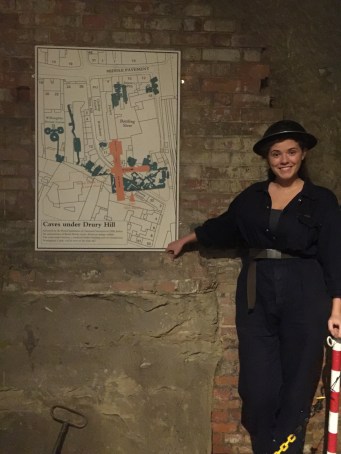 As we wound our way through the tunnels, we were transported to World War II, where another interpreter regaled us with tales of how the caves were turned into bomb shelters. A new cave was dug under a factory and could hold 8,000 people! Although not a primary target for the Germans, Nottingham was bombed during the war. With all of the bomb shelters, most were spared. (Approximately 120 deaths)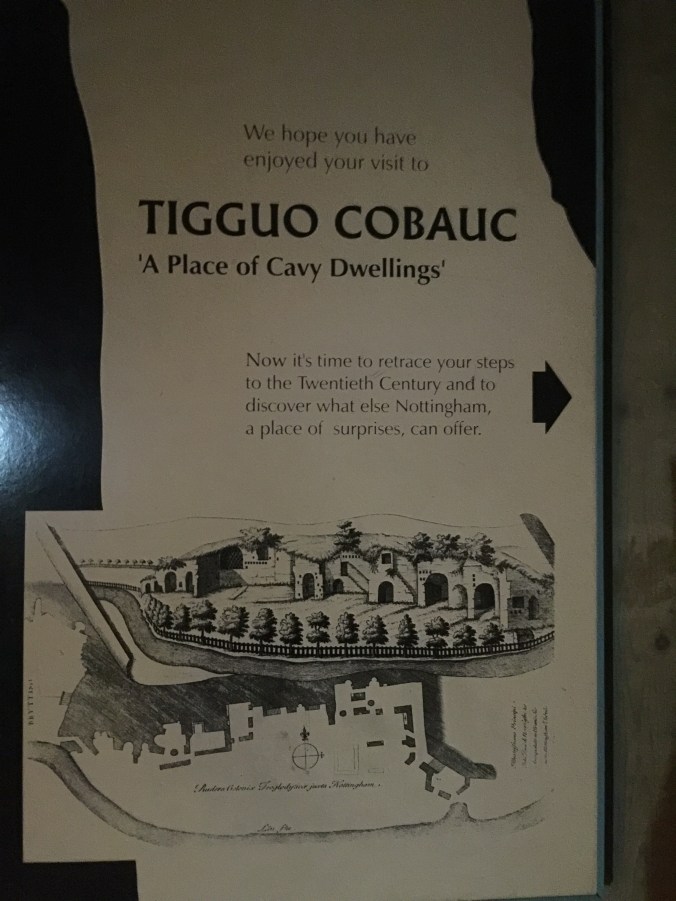
 marjorie light